Guide
Single-pass welding of thick steel plate
What single-pass welding is, why it is difficult on thick plate, and how a contactless electromagnetic weld pool support makes it work in production.
How thick plate is welded today
Butt joints in thick steel plate — in wind-tower sections, pressure vessels or ship panels — are usually welded with submerged-arc welding (SAW) or gas metal arc welding (MAG). Because a single pass cannot fill the joint, the plate edges are first beveled into a V, Y or X groove. The groove is then filled layer by layer: a root pass, many filler passes and a cap pass, often from both sides with back-gouging in between.
Every pass costs welding time, filler wire, flux or shielding gas and energy. And every pass brings heat into the component again, which adds to distortion and rework.
Why one pass is difficult
To weld a joint in one pass, the heat source has to penetrate the full plate thickness. High-power lasers and laser-hybrid processes can do this. The problem lies at the root: the molten metal forms a column as tall as the plate is thick. Its weight presses on the root, and in thick plate surface tension alone can no longer hold it. The melt sags or drops out, and the joint is not filled.
Conventional weld pool backings such as backing strips or ceramic backing are no option here: the laser beam penetrates the full plate thickness and would simply destroy them.
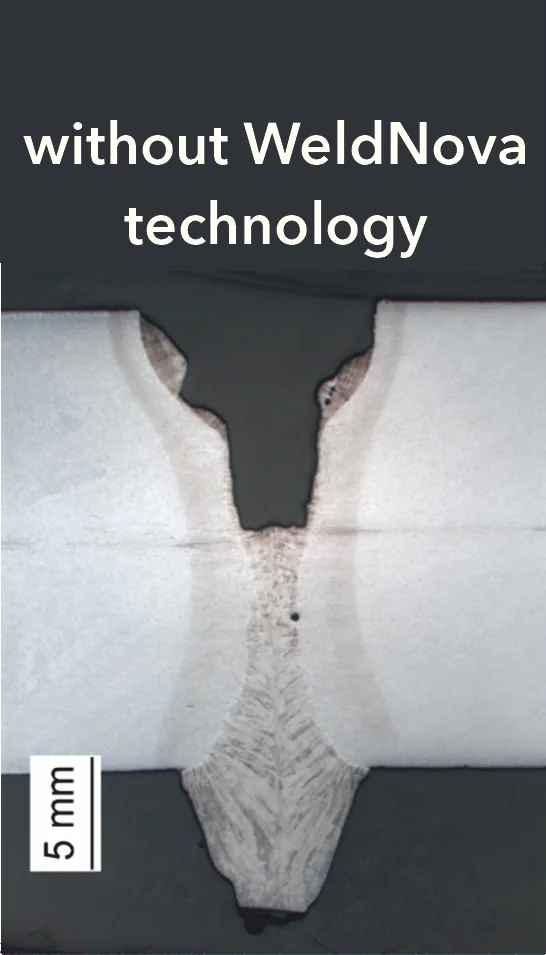
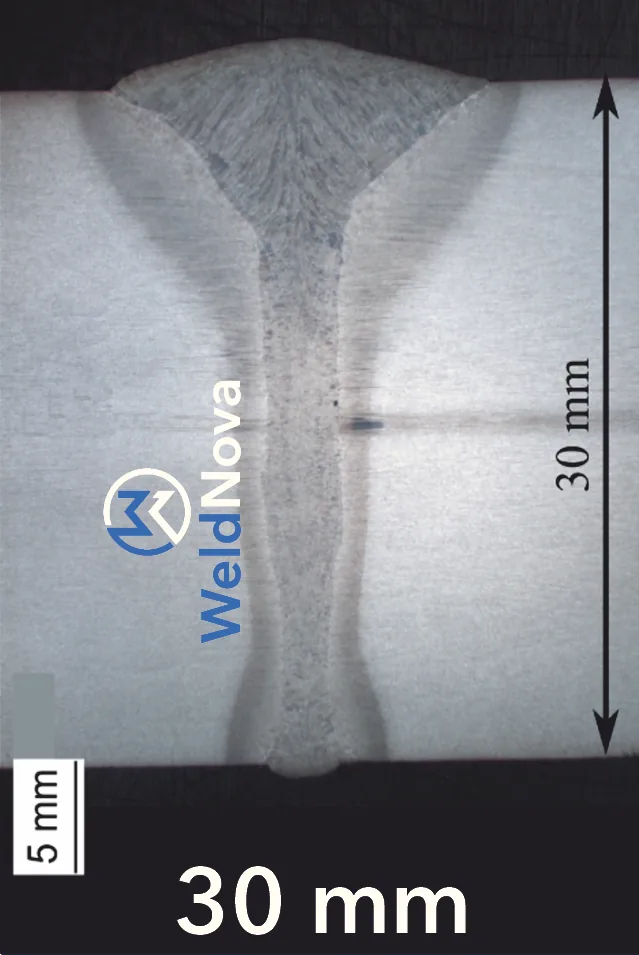
How the weld pool support works
WeldNova places a system below the joint, without touching the component. Its magnetic field acts on the molten metal and produces a force that pushes the melt upward — against its own weight. The root stays in shape, and the joint is welded through the full thickness from one side, in a single pass.
Because the support works without contact, there is no backing to fit, remove or replace. The welding head works from above with ultra-high-power lasers; the process runs automatically and reproducibly, which is the basis for qualifying the weld.
- Apply the field. The magnet system below the joint supports the weld pool without contact.
- Weld in one pass. Laser and arc join the plates through the full thickness from one side.
- Qualified seam. A reproducible weld, qualified for your component.
What changes in production
- Simple joint preparation. A square butt joint with a flame-cut edge is sufficient; groove preparation is no longer needed.
- One pass instead of many. Far less welding time per meter of seam.
- Less material and energy. A narrow seam needs far less filler material and energy than a filled groove.
- Less heat in the component. Fewer thermal cycles mean less distortion and less rework.
- Welded from one side. No back-gouging and no second weld from the reverse side.
- Automated and reproducible. Suited to series production and to procedure qualification.
How large the effect is for your components depends on plate thickness, weld length and current process. The ROI calculator gives a first estimate; our case study shows a worked example from wind-tower construction.
Multi-pass and single-pass compared
| Multi-pass (SAW / MAG) | Single-pass with WeldNova | |
|---|---|---|
| Joint preparation | Beveled groove (V, Y or X) | Square butt joint, flame-cut edge |
| Passes | Root pass, filler passes, cap pass | One pass through the full thickness |
| Access | Often both sides, with back-gouging | One side |
| Root support | Backing strip, ceramic backing or back-gouging | WeldMagnet: contactless electromagnetic weld pool support |
| Filler material | Large groove volume to fill | Narrow seam, far less filler |
| Heat input | Many thermal cycles | One thermal cycle, less distortion |
Where single-pass welding fits
Single-pass welding pays off where long butt seams in thick plate are welded regularly. Our machines are designed for sections up to 35 mm thick.
- Wind energy — tower sections and tubes: more sections per station, lower cost per meter of weld.
- Pressure vessels — thick-walled vessels and shells: reproducible, qualifiable seams.
- Shipbuilding — panels and thick-walled sections: less distortion, less rework.
Where the technology comes from
The electromagnetic weld pool support was developed over many years of research in Division 9.3 Welding Technology at the Federal Institute for Materials Research and Testing (BAM). WeldNova was founded as a BAM spin-off (opens in a new tab) to bring it into industrial production. SPRIND, the Federal Agency for Breakthrough Innovation, describes the technology in its article “The dream of a better weld” (opens in a new tab).
Further questions are answered in our FAQ.
Is your seam a candidate for single-pass welding?
Plate thickness, material, weld length per year — we assess feasibility and run the numbers on your case.